Showing posts with label Beautiful Places. Show all posts

Tuesday, September 20, 2011

Dubailand: The Most Amazing and Luxurious Amusement Park in the World


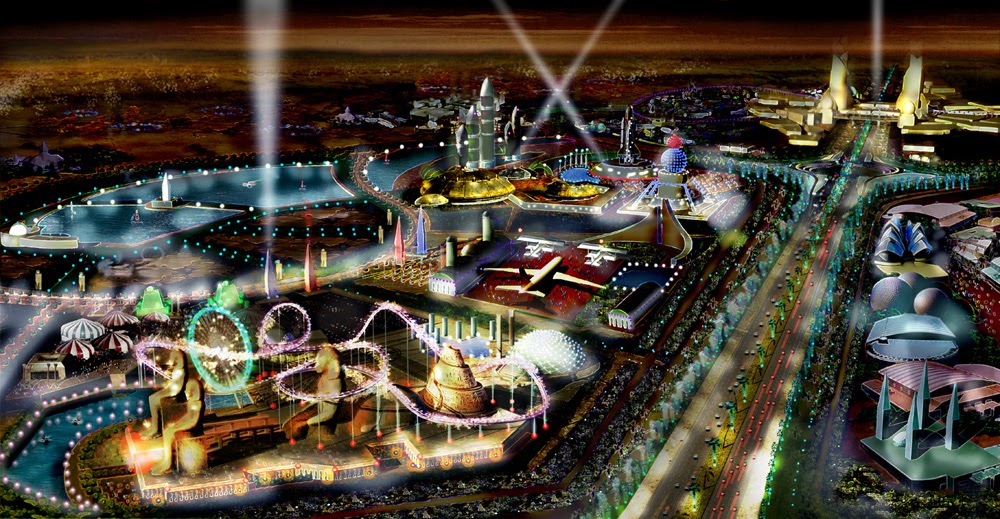
Dubailand is an entertainment complex being built in Dubai, United Arab Emirates, which is owned by Tatweer (which belongs to Dubai Holding). When announced in 2003 it was one of the most ambitious leisure developments ever proposed anywhere in the world, but development has been severely impacted by global recession and Dubai's financial crisis. The development was put on hold in 2008; however in May 2011, it was announced that a revised master plan for the mega-project will be announced by the end of 2011. The project is now expected to be scaled down in design to meet the Dubai's battered real estate sector. The construction will be resumed by the end of 2011.


Dubailand (Dubai Land) is a very large entertainment, leisure, and tourism area under development in Dubai by Dubai Properties Group, a subsidiary of Dubai Holding. Total size is a massive 3 billion square feet (24 January 2010 press release figure). Project joint ventures established include agreements with Formula 1, Hollywood theme parks, and Tiger Woods.


List of Dubailand Projects
A total of 26 mega projects expected - 3 scheduled to be open by end 2006, 10 open by 2009, the rest open by 2012. Total of 300,000 employees with 200,000 visitors every day. At least, that was the plan. As of the beginning of 2009, there's not quite so much ready.

  • Al Barari - villa handovers started in 2009
  • Al Kaheel - educational theme park about horses.
  • Al Sahara Kingdom
  • Al Sahra Desert Resort - restaurants, boutique hotel, souq, amphitheatre. Area 40 million sq feet? Includes the Jumana Secret of the Desert show.
  • Aqua Dunya themed water park - with large ship hotel operated by Jumeira international
  • Astrolab Resort
  • Bawadi Tourism Area - 10 km strip between Al Barsha and the Lahbab Road with over 50 hotels, shopping centers, entertainment. Just like the Las Vegas strip except bigger with more lights but no casinos. Or maybe casinos with no gambling. Or maybe a strip of road with no hotels, shops, or anything else except sand. At least, that's how it looks at the start of 2010.

  • Bawadi Mall - Phase I opening scheduled for 2012, eventually expected to be larger than Mall of Arabia
  • Beauty Land (Beautyland Dubai) - a ladies resort and development with a beauty museum, beauty academy, a beautiful boutique hotel, and a beautiful boulevard with cosmetics and beauty product shops.
  • Botanical Gardens - with residential villas (Al Barari?)
  • City of Arabia - with artificial dinosaur park and large shopping mall
  • Dreamworks Dubai theme park
  • Dubai Autodrome - racetrack in Dubai Motor City
  • Dubai Bazaar - traditional Islamic marketplace and souq.
  • Dubai Country Club - new one behind Arabian Ranches, opening in 2010?


  • Dubai Education City - another name for the Taaleem schools complex?
  • Dubai Golf City - five golf courses, golf academy, golf communities and villages, retail shopping areas, hotel resort and spa.
  • Dubai Lifestyle City - a residential community with a Tuscan theme for posh people, developer ETA Star. Infrastructure complete early 2009.
  • Dubai Motorcity - see Motor City Dubai.
  • Dubai Outlet City - with Dubai Oulet Malll
  • Dubai Outlet Mall - Phase I open August 2006

  • Dubai Heritage Vision - reportedly opening by end 2006
  • Dubai Sports City - Dubai Cricket Stadium and other sports facilities, along with residential and commercial developments
  • Dubai Wheel (Great Dubai Wheel or Wheel of Dubai) - giant Ferris wheel similar to the London Eye but bigger. Of course.
  • Emirates Planetarium (within the Restless Planet)
  • F1 theme park and race track
  • Falcon City of Wonders (Falconcity) - residential complex with replicas of global icons, including an Eiffel Tower bigger than the original? Also replicas of the Hanging Gardens of Babylon, the Leaning Tower of Pisa, the Pyramids, the Taj Mahal. Area of 4 million square metres in the shape of a falcon. Includes a Pharaohs Theme Park.


  • Freej Dubailand?
  • Global Village (eventually a permanent one)
  • Health Farm
  • Islamic Culture & Science World
  • Legoland Dubai?
  • Mall of Arabia - largest shopping mall in the world when forecast to open in 2010 one day, in City of Arabia
  • Motor City Dubai - includes the Dubai Autodrome, residential communites and retail shops, Formula One Theme Park, racing school, F1 track, museum, restaurants, and so on.
  • Palmarosa
  • Plantation Polo and Equestrian (Equine) Center - reportedly opening by end 2006, but didn't. Facilities include 3 polo fields, 5-star hotel resort and spa, veterinary hospital for horses, polo academy.
  • Restless Planet - Jurrassic Park comes alive. Sort of.
  • Riverside - wellness resort and health farm. Part of Dubai Beautyland?
  • Six Flags Dubai theme park
  • Snow Dome Dubai (or Dubai Snowdome / Skidome / Dubai Sunny Mountain Ski Dome)
  • Taleem Education City (or Dubailand Education City?) - for Taaleem / Beacon schools and HQ
  • Tiger Woods Dubai - exclusive Golf Community in Dubai
  • Universal Studios Dubailand theme park
Dubailand progress update 24 January 2010 press release - events in 2009
  • Al Barari villas handed over
  • Butch Harmon School of Golf open at The Els Club
  • Dubai International Cricket Stadium open - seats 25,000
  • Dubai MotorCity - 1300 commerical, retail, and residential apartments handed over
  • Global Village 14th year started its 14th year (opening date 22 November 2009, closing date 27 February 2010, telephone +971-4-3624114)
  • J.W. Marriott Hotel in Dubai Lifestyle City - construction started
  • Leyan community apartments and villas handed over
  • Royal Caribbean International - agreement signed with Dubailand to bring cruise passengers to Dubailand attractions. Brilliance of the Seas will be in UAE waters from 18 January to April 2010.
  • The Villa villas handover started
  • Victory Heights golf community - villa handover started in June 2009

Dubailand facts and figures update 25 February 2008 press release
  • Dubailand project value AED 235 billion (US$64 bn)
  • Chief executive officer is Mohamed Al Habai (Mohammed Al Habbai)
  • Phase I of Dubailand sceheduled to open in 2010, final completion date target is 2020
  • Bawadi tourist area will add 60,000 hotel rooms to the 42,000 rooms already existing in Dubai, in 51 hotels on a 10km stretch of road.
  • 15 million tourists to Dubai per year expected by 2015 (double the 7.7 million tourists that visited Dubai in 2007).
  • Average visitor spend in Dubai is $40-$80 per day and average length of stay is 2½ days. CEO Mr Al Habai forecasts average stay and spend of 4-7 days and $240 per person per day.
  • By the time Dubailand is completed, "more than 250,000 staff will be working in the theme parks, all accommodated in dedicated units."
  • "Consultants still question whether investors in Dubailand will get a sufficient return, but this skepticism has not deterred investments by the biggest local and regional families. Rome was not built in a day, and for once even Dubai is looking 12 years ahead.
DUBAILAND PROMOTIONAL VIDEOS


Wednesday, August 3, 2011

Seven Wonders of the Ancient World


Seven Wonders of the Ancient World

Seven Wonders of the Ancient World: Greek list of seven amazing works of architecture. The selection was several times adapted to cultural changes.
The ancient Greeks loved to make lists. For example, they had lists of admirable epic poets (starting with Homer and Hesiod) and tragic playwrights (Aeschylus,SophoclesEuripides). These lists became popular when, after the conquests ofAlexander the Great, many Greeks settled overseas. Their position as an elite in countries like Egypt, Babylonia, and Bactria depended on their being-Greek, and canons of exemplary texts were important: unlike the native population, a real Greek had read these authors and knew how and when to quote them.
The list of Seven Wonders of the World belongs to this category of texts: splendid buildings, worthy of emulation. The original list, now lost, contained seven Greek buildings, but in the early third century, non-Greek monuments were included as well. It expressed the novel idea that the barbarians could also produce fine works of art, an idea that can be found in the books by several scholars and philosophers of the first generations after Alexander the Great.

One of the first known lists was made by Antipater of Sidon, who lived in the first half of the second century. It survives in the collection of poetry known as the Anthologia Palatina (9.58):
  1. The walls of Babylon
  2. Phidias' statue of Zeus in Olympia
  3. The hanging gardens of Babylon
  4. The colossus of Rhodes
  5. The pyramids of Egypt
  6. The Mausoleum of Halicarnassus
  7. The temple of Artemis in Ephesus
Later, the first item was replaced by the Lighthouse of Alexandria, and this has become the canonical list. 
1.   
      
  1. The Lighthouse of Alexandria
  2. Phidias' statue of Zeus in Olympia
  3. The Hanging Gardens of Babylon
  4. The colossus of Rhodes
  5. The pyramids of Egypt
  6. The Mausoleum of Halicarnassus
  7. The temple of Artemis in Ephesus

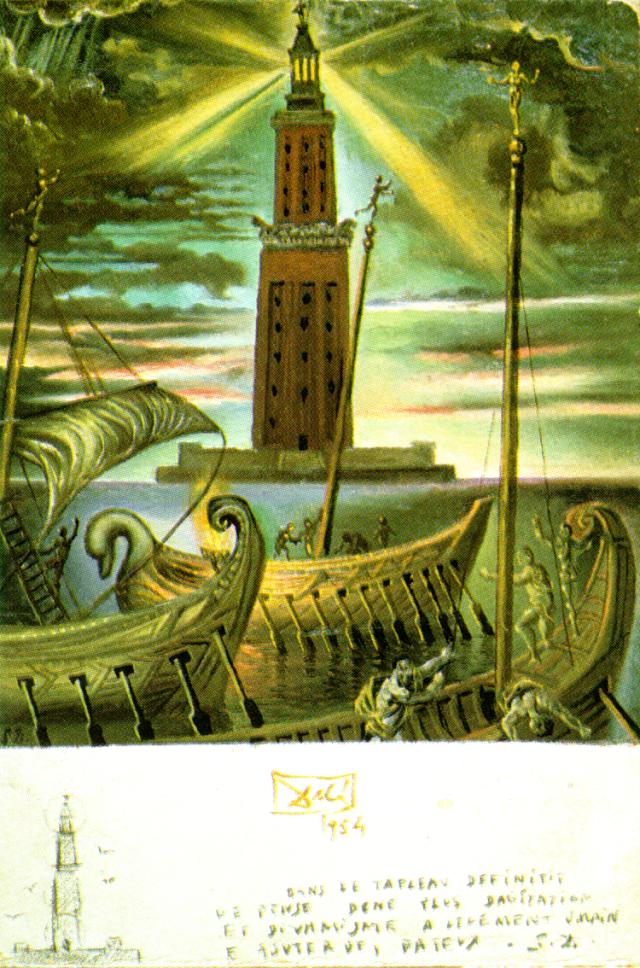
    1. The Lighthouse of Alexandria


    Commissioned in 299 BCE by king Ptolemy I Soter of Egypt, the Lighthouse of Alexandria was built by an architect named Sostratus; it was finished in 279, when Ptolemy II Philadelphus was on the throne. The monument is often called Pharos, after the island on which it was erected. It consisted of three main elements:
    1. A square base 56 meters high;
    2. An octagonal middle 28 meters high;
    3. A circular top of perhaps another 28 meters; the total was more than 100 meters.
    Although it was originally just a high tower that made the port of Alexandria visible from far away, at some time in the first century BCE, it was converted into a real lighthouse, so that sailors could benefit from it by night as well. It was destroyed by an earthquake in 1326. The sequence (square, octagonal, circular) has inspired more recent towers.

    2. Phidias' Statue of Zeus in Olympia


    The Athenian sculptor Phidias already had a great reputation when in 437 BCE he and his colleagues Colotes and Panaenus settled in Olympia to make the statue of the supreme god of the Greeks, Zeus, in whose honor the Olympic Games were held. The statue is now lost, but is shown on coins and gems, and described by the Greek author Pausanias; from this evidence, we known that the god was shown as a seated figure of about twelve meters high. In one hand, he carried a statue of Nike, in the other a scepter. All kinds of other figures, like lions and sphinxes, warriors fighting against Amazons, more Nikes, and mythical beasts surrounded the main body. The statue was made of gold and ivory, and was carefully repaired when necessary. In the fourth century CE, when the statue was almost eight centuries old, the Roman emperor Constantine the Greatordered it to be dismantled, and had it transported to Constantinople, the new capital of the Roman empire. The subsequent history of Phidias' Zeus is not recorded.

    3. The Hanging Gardens of Babylon


    The Hanging Gardens of Babylon are mentioned by Alexander Polyhistor quoting Berossus, who tells us that king Nebuchadnezzar built this park for his wife, a princess from Media. By creating this artificial Zagros mountain range, he hoped that she would forget her homeland. Although Berossus knew the city very well, no scholar has been able to find traces of the hanging gardens, and it has convincingly been shown that Berossus' statement is not by Berossus at all. In fact, Berossus has quoted the cuneiform text known as the East India House Inscription -and this part is accurate- and Alexander Polyhistor has added the Gardens.

    4. The Colossus of Rhodes


    The Colossus was erected to commemorate the outcome of the blockade of the city of Rhodes by king Demetrius Poliorcetes. In 305-304, he had attempted to conquer this important port, but the siege had been unsuccessful (text), and the Rhodians ordered Chares of Lindos to build a statue of Helios, the sun god. The monument, which was nearly thirty meters high and stood on a  pedestal that added another ten meters, guarded the entrance of the harbor. It collapsed after an earthquake in 227/226 BCE, but the remains were still shown to tourists in the Roman age. During the reigns of the Roman emperors Claudius and Nero, an artist named Zenodorus made a copy in Gaul (a statue of Mercury), and he was later invited to build a similar statue in Rome, which became known as the "colossus Neronis". It was finished during the reign of Vespasian. The most famous monument inspired by the Rhodian Colossus is the Statue of Liberty in New York.

    5. The Pyramids of Egypt


    Between c.2630 and c.1640, the Egyptian pharaohs erected tombs for themselves that were shaped like artificial mountains. The oldest pyramids were built by the rulers of the third dynasty; king Djoser was the first to pile several square tombs (mastabas) of decreasing size on top of each other, and created the first step pyramid. The true pyramid, which is a real triangle, was developed during the reign of Snofru, a king of the fourth dynasty. The famous pyramids of Cheops, Chefren, and Mycerinus at Gizeh were erected by Snofru's successors. Later generations built smaller monuments, but the large monuments of the fourth dynasty continued to impress the people. The pyramids are the only one of the Seven Wonders of the Ancient World that survives more or less intact.

    6. The Mausoleum of Halicarnassus


    The Mausoleum of Halicarnassus was the tomb of Maussolus, satrap of Caria, who had come to power in 377 and had died in 353. His wife and successor Artemisia ordered the construction of a monument that was to surpass all others: it was erected out of bricks but covered with white Proconnessian marble, and was at least 41 meters high. The greatest sculptors of Greece, including Scopas, were involved in the project, and made the hundreds of statues that graced the four sides. The proud tower was ultimately destroyed by the Rhodian knights in 1522, who used the stones to build a castle (which is now the Archaeological Museum of Bodrum). Today, the remains of this once grandiose monument offer a sad sight.

    7. The Temple of Artemis of Ephesus


    The temple of Artemis in Ephesus was a very ancient sanctuary for a mother goddess who protected pregnant women; it may have antedated the arrival of the Greeks in Asia Minor. According to Pliny the Elder, Natural history, 36.95, it was built in a marshy area to protect it against earthquakes. Lydian kings like Croesus contributed to the building of this temple, and later, the Persians patronized the cult; the high priest was called the Megabyxus, a Persian name that means "the one set free for the cult of the divinity". The sanctuary burned down in the summer of 356 BCE, an event that was remembered because it coincided with the birth of Alexander the Great. Many architectural pieces can now be seen in the British Museum; in Ephesus itself, of the 127 columns that once supported the roof of this wonderful building, only one remains.


    Sunday, June 26, 2011

    Socotra Island: Mysterious and Beautiful


    (images credit: Jan Vandorpesocotra)

    Maybe it has happened to you that after watching a very nice movie or a documental about aliens, you imagine yourself walking on the surface of another planet looking at strange plants, creatures, and landscapes....
    It is just science fiction......you bet. Nevertheless, let me tell you that there is one amazing place on Earth that resembles the surface of another planet. One place that is going to take you beyond your imagination.


    There is a mysterious and magical island named Socotra in the Republic of Yemen. This island, which is part of a group of 4 islands, has been geographically isolated from mainland Africa for the last 6 or 7 million years. Like the Galapagos Islands, this island is teeming with 700 extremely rare species of flora and fauna, a full 1/3 of which are endemic, i.e. found nowhere else on Earth. 


    (images credit: dianadrz, Irina Travina)


    (image credit: socotra)

    The climate is harsh, hot and dry, and yet - the most amazing plant life thrives there. Situated in the Indian Ocean 250 km from Somalia and 340 km from Yemen, the wide sandy beaches rise to limestone plateaus full of caves (some 7 kilometers in length) and mountains up to 1525 meters high. 


    (image credit: Marco Pavan)

    The name Socotra is derived from a Sanscrit name, meaning "The Island of Bliss"... Is it the beaches? The isolation and quiet? or the strange and crazy botanical allure?


    Alien-looking plants: H. P. Lovecraft's secret inspiration?

    Was the famous Chtulhu myths creator aware of these forbidding mountains with their hauntingly weird flora (think of plant mutations from his "The Color out of Space") ? We almost tempted to call Socotra the other "Mountains of Madness" - the trees and plants of this island were preserved thru the long geological isolation, some varieties being 20 million years old... 

    We begin with the dracena cinnibaris or Dragon's Blood Tree, the source of valuable resin for varnishes, dyes, and "cure-all" medicine; also (predictably) used in medieval ritual magic and alchemy -


    (image credit: Christian Besnier)

    The branches spread out into the sky and from below appear to hover over the landscape like so many flying saucers... and from above they have a distinct mushroom look:


    (image credit: Jan Vandorpe)


    (image credit: dianadrz)

    There is also the Desert Rose (adenium obesium) which looks like nothing so much as a blooming elephant leg:


    (images credit: Jan Vandorpe)


    (image credit: Denis Romanov)

    Dorstenia gigas - apparently does not require any soil and sinks roots straight into the bare rock:


    (images credit: Jan Vandorpe)

    It also has a distinct personality and likes to smile for the camera:


    (image credit: Tomas van Houtryve)

    Somewhat similar to the weird Dorstenia gigas, is this "bucha" vegetable, found as far north as Croatia. I hope it's not pregnant with anything malignant inside this sack. John Wyndham (with his "The Day of the Triffids") would've loved it:


    (image credit: Damir)

    Also found in Socotra's landscape is the ever-strange and extremely rare Cucumber Tree (dendrosicyos socotranum) - and yes, it's related to what's sitting in a pickle jar in your fridge:


    (image credit: Jan Vandorpe)


    Getting around can be a challenge, as there are almost no roads

    Despite the fact that this island has around 40,000 inhabitants, the Yemeni govenment put in the first roads just 2 years ago - after negotiations with UNESCO, which has declared this island a World Natural Heritage Site. I would prefer a camel ride to what is bound to be a bumpy and slow 4x4 ride... It is a quiet and peaceful enclave in an otherwise troubled world. If you decide to visit there, you can forget about beachfront hotels and restaurants; this island is geared towards eco-tourism and sustaining the local economy and way of life.


    (images credit: Adele ObiceMarco PavanDenis Romanov)


    This island is a birder's paradise as well, with 140 different species of birds; 10 of which are not found anywhere else in the world. A unique Socotra warbler, sunbird, starling, bunting, sparrow and cisticola are among the ones found here. There are also Socotra Cormorants:


    (images credit: Magellan ToursRafeek Manchayil)

    Want to see some fairy-tale (and possibly haunted) shipwrecks? There are diving tours available... Hopefully some IMAX crew would film it in all its glory one day.


    (image credit: socotra)

    To give you a glimpse of Socotra's and Yemen's in general totally unique architecture, check out this place located on the mainland:

    Al Hajarah, Yemen - Walled city in the mist

    Computer game designers take note - this mysterious city in the foggy Yemen's Haraz Mountains can surely fire up imagination of anybody who decides to explore it:


    (image credit: Jan Vandorpe)

    (image credit: Bellosta)

    (image credit: Michaela Diener)

    Now the decision is yours.......You can pack your bags, for this is on our good old planet Earth, no interstellar visa required.


    (image credit: socotra)