Showing posts with label Japanese Culture. Show all posts

Monday, March 21, 2011

Beautiful and strange Japanese shoes: "Jika-tabi (地下足袋)"


I saw so many different and curious things in Japan. Some of them were totally amazing. Now I am back in my country I regret i didn't buy a pair of JIKA TABI. I still don't understand why I didn't buy them......Well, let me tell you what jika tabis are. Jika-tabi (jee' kah tah bee) are Japanese worker boots. They have been used traditionally by construction workers, farmers, painters, road workers, and others since the late Meiji Period (around 1912). They are also worn during festivals and by traditional Japanese musicians such as Taiko drummers. We believe that the sleek designs and comfortable fit of jika-tabi make also them ideal for everyday attire. Now lots of people are using jika tabi because they are so cool.

Jika-tabi come in a variety of types, colors, and styles. The traditional fastening device is a series of metal tabs (kohaze) that hook into a series of loops. A 12-tab tabi reaches about half way up to your knee (which is why they are sometimes called tabi "boots"). Laced, velcro, and zipper versions are also available.

The sole of traditional jika-tabi are made of pliable natural rubber. Soft enough to be flexible, but stiff enough to protect the wearer's foot from ground debris (remember that they are traditionally working boots). The rest of the shoe is constructed entirely of lightweight and breathable cotton except where noted otherwise.

 The most distinguishing aspect of jika-tabi is no doubt the split-toe design that separates the big toe from the other toes. This feature enhances their comfort, stability, and is a great conversation starter.  For me they are great and they look cool. I promise to buy a pair of jika tabi in my next trip to Japan.

Tuesday, March 8, 2011

日本語のクラス

こんにちわ みんな様。私はマリエラです。私はエルサルバドルにすんでいます。学校二働いています。私は英語教師です。長崎大学に勉強しました。私は日本語が大好きです。今エルサルバドル二います。でも日本語を勉強しています。来年日本へ帰る。私の恋人が日本にいます。恋人の名前はマスドです。マスドさんが会いたいです。日本でたくさん日本人友達と会いました。それから日本へ行きたいです。どうもありがとう。私のブログへようこそ。

Origami for everyone!!!!! みんなの折り紙


for learning beautiful origami models

One of the hobbies I love the most is origami. Besides I don´t feel the time when I am doing it, my brain is working so hard and developing skills in myself. I really admire Japanese people, and after learning origami, I understand very well why they are so practical and intelligent.
Origami (折り紙, origami?) (from oru meaning “folding”, and kami meaning “paper”) is the ancient Japanese art of paper folding. The goal of this art is to create a representation of an object using geometric folds and crease patterns preferably without the use of gluing or cutting the paper,and using only one piece of square paper.


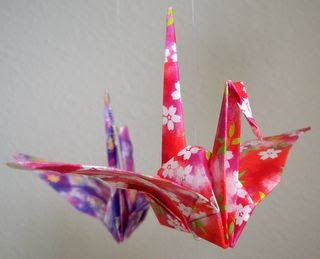
Origami only uses a small number of different folds, but they can be combined in a variety of ways to make intricate designs. The most well known form is probably the Japanese paper crane. In general, these designs begin with a square sheet of paper whose sides may be different colors or prints.


The origin of the art began as Chinese Paper Folding. The Japanese origin began in the 6th century when Buddhist monks from China carried paper to Japan. The first Japanese origami is dated from this period.
Origami had already become a significant aspect of Japanese ceremony by the Heian period of Japanese history. Samurai warriors would exchange gifts adorned with noshi, a sort of good luck token made of folded strips of paper. Origami butterflies were used during the celebration of Shinto weddings to represent the bride and groom.


In the 1960s the art of origami began to spread out, first with modular origami and then with various movements developing, including the kirikomi. Origami is now an international art.